Choosing right: not just power, but also control
In professional backlighting projects, simply covering a surface is not enough:
it is also key to be able to control the light, simplify the installation and guarantee electrical stability.
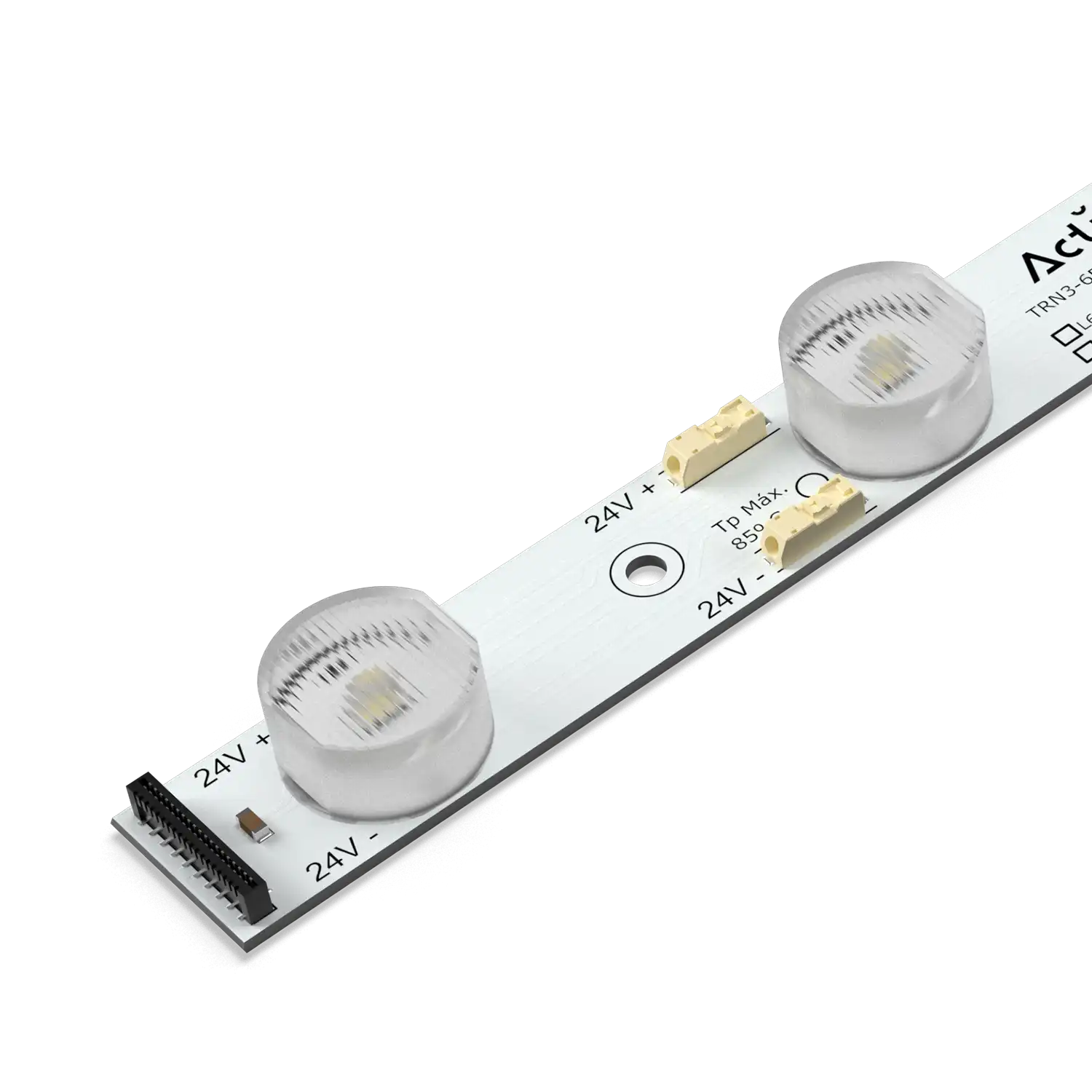

Parallel Flex L is positioned as a dimmable side lighting solution, where the value is not only in the light, but in how it is installed and controlled.
Positioning within the Actilum ecosystem
| Solution | Function |
|---|---|
| Luxpanel | premium homogeneous surface |
| Luxpanel Dot | selective lighting |
| Pixel | dynamic lighting |
| Parallel L | large format rigid non-adjustable |
| Parallel Flex L | adjustable linear system with optimized connection |
When to choose Parallel Flex L
Parallel Flex L is the right choice when the project requires:
- Dimming
- Integration with control systems
- Fast and safe installation
- Reduction of on-site errors
- Stability in large installations
- Backlighting in lightbox or signage
When NOT to choose Parallel Flex L
Avoid use when needed:
- Completely homogeneous surfaces → use Luxpanel or Frontline.
- Maximum structural power without regulation → use Parallel L
- Dynamic or addressable effects → use Pixel.
- Simple solutions without light control → use basic systems.
Parallel Flex L vs Parallel L
Parallel L
- Modular rigid system
- Increased structural strength
- Not adjustable
- Oriented to large format coverage
Parallel Flex L
- Rigid system with Flex connection
- Current regulation (PWM)
- Progressive ignition
- Faster and safer installation
Conclusion:
Parallel L → power and structure
Parallel Flex L → control, regulation and installation efficiency.
Parallel L vs Luxpanel
Luxpanel™
- Optical panel
- Homogeneous surface with no visible spots
- Ultra-thin integration
Parallel Flex L
- Linear side backlighting system
- Requires volume (lightbox)
- Intensity regulation
- Module-based distribution
Conclusion:
Luxpanel → total homogeneity
Parallel Flex L → intensity control in linear systems.
Parallel Flex L vs Parallel Pixel
Parallel Pixel
- Individual LED control
- Dynamic effects and animations
- Active lighting
Parallel Flex L
- Static lighting
- Global dimming
- Stability and efficiency
Conclusion:
Pixel → movement and effects
Parallel Flex L → stable and dimmable light control.
Parallel Flex L vs. standard LED strips
Conventional LED strips
- Require manual wiring
- Increased risk of installation errors
- Limited or unstable regulation
- Less control in large systems
Parallel Flex L
- Flex connection without complex wiring
- Faster installation
- Professional PWM control
- Integrated soft start
- Greater stability in long lines
Conclusion:
Parallel Flex L improves installation, control and reliability over standard solutions.
Parallel Flex L is not a flexible variant of Parallel L, but an evolution of the linear system oriented to:
- Control
- Regulation
- Efficiency
- Installation
It enables the construction of professional backlighting systems where light is not only installed, but also precisely managed.
More info about...
Want to see how it integrates into your project?
Professional linear lighting with total control Parallel Flex L is a 24 V rigid linear …
Rigid linear system with Flex connection and PWM control Parallel Flex L is a 24 …
Dimmable lighting for real projects Parallel Flex L is used in projects where the lighting …