



LED Backlighting for Lightboxes and Stretch Ceilings: Two Applications, Two Requirements

Frontline S-TW18 is a dynamic white LED solution designed for backlighting projects where a single technology can meet a wide range of needs.
Backlighting an advertising lightbox is not the same as illuminating a stretch ceiling.
In a lightbox, lighting is primarily used to enhance a graphic, a brand, or a visual campaign.
In a stretch ceiling, light can be part of the ambient or general lighting of the space, directly influencing comfort, visual perception, and lighting quality.
For this reason, the Frontline S-TW18 should be understood from two different perspectives:
- Backlighting for Communication
- Backlighting for illumination
This difference is key to correctly defining the project.

Lightbox: When Light Is Needed to Make a Chart Visible
In a light box, the main goal is usually to achieve a visible, uniform surface with sufficient visual impact.
Light serves as a medium for communication.
The focus is on:
- Uniformity on the graph
- Good visual readability
- Commercial Impact
- Absence of distinct shadows
- Thin-film integration
- Stability of the illuminated surface
In this type of application, adjustable white balance is not always a key requirement. Many advertising light boxes use a fixed color temperature, because what matters is that the graphic looks good and maintains a consistent appearance.
Similarly, factors such as a very high CRI or extreme efficiency are not usually the deciding factors when it comes to a poster, a textile graphic, or a backlit promotional display.
For lightboxes, the Frontline S-TW18 offers a linear, uniform, and adaptable solution, which is particularly useful when controlled backlighting is required in thin lightboxes.
Stretch Ceilings: When Light Becomes Part of the Space
With a tensioned ceiling, the logic changes.
Light no longer serves merely as a visual aid. It can become a source of ambient or even general lighting.
This makes the selection criteria more stringent.
It’s starting to play a bigger role in tensioned ceilings:
- Luminous power
- Energy Efficiency
- Visual Comfort
- Color stability
- The harmony between warm and cool tones
- Spectrum Quality
- The CRI required for the project
- The sensation of natural light or circadian light, if applicable.
Here, dynamic white makes more sense, because it allows you to adjust the atmosphere of the space using different color temperatures.
Warmer lighting can create a sense of comfort and intimacy.
A more neutral light can work well for everyday use or in high-traffic areas.
A cooler light can enhance the feeling of brightness or activity.
In stretch ceilings, the Frontline S-TW18 should be considered not only as a backlighting module, but as part of an overall lighting strategy for the space.
Dynamic White: More relevant when light changes the experience
The Frontline S-TW18 allows you to work with dynamic white, combining warm and cool light to create intermediate scenes.
This feature may have varying levels of importance depending on the project.
In Lightbox, dynamic white can be useful in special applications, storefronts, commercial settings, or campaigns that aim to change the perception of the graphic.
But for many advertising light boxes, a fixed temperature may be sufficient.
With stretch ceilings, dynamic white is often more valuable because light directly affects the user experience.
It allows you to customize the space based on:
- Schedule
- Use of the Environment
- Planned Activity
- Desired sensation
- Comfort Level
- Project image
Therefore, the decision should not be based solely on whether the product allows for adjustments to the Kelvin setting, but rather on whether that adjustment provides real value to the application.
Two Ways to Understand a Backlit Surface
A backlit surface can serve a wide variety of purposes.
- It could be a graphic element.
- It can be a built-in light source.
- It can serve as a decorative element.
- It can be a tool for altering the perception of space.
In a lightbox, the backlit surface is usually associated with an image, a brand, or a message.
In a tensioned ceiling, the illuminated surface affects the entire atmosphere and the way the space is perceived.
This difference determines the choice of LED system, power, color temperature, color rendering, and technical requirements.
Frontline S-TW18 can address both scenarios, but each must be evaluated using different criteria.
When the Frontline S-TW18 fits into the lightbox
The Frontline S-TW18 may be a good choice for a lightbox when the project requires:
- Uniform backlighting
- Thin-walled light boxes
- Backlit textile graphics
- Indoor advertising displays
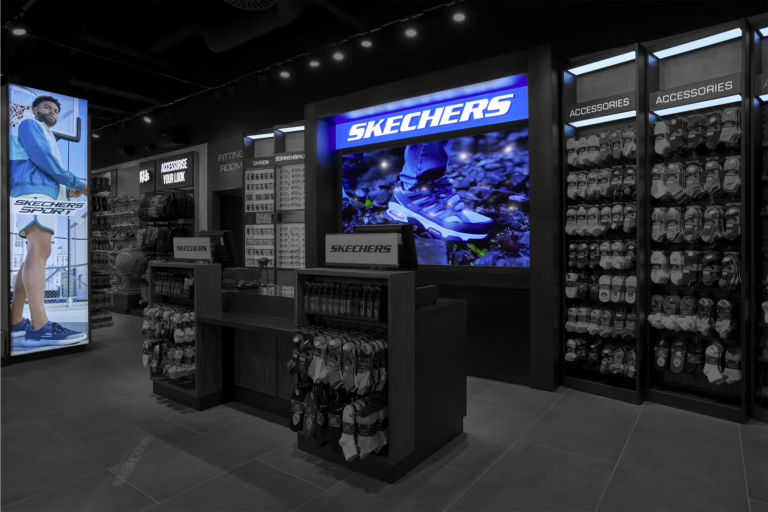
- Visible retail spaces
- Integration into retail settings or interior display cases
- Dynamic white balance option for special applications
In this context, the product is understood as a solution for giving the graphic design a visual presence.
The main goal is for the light to enhance communication without casting shadows, creating visible spots, or causing unwanted distortions on the surface.
When the Frontline S-TW18 Fits into Stretch Ceilings
For tensioned ceilings, the Frontline S-TW18 may be a good choice when you’re looking for:
- Continuous luminous surface
- Dynamic Warm-Cool White
- Integrated ambient lighting
- Greater light output than a sign
- Scenes that can be adapted to suit the application
- A sense of spaciousness and clarity
- Seamless integration with no visible light fixtures
In this case, the backlighting is no longer just a visual element; it becomes part of the space’s lighting experience.
For this reason, in stretch ceiling projects, it is important to review the requirements: if a very high CRI, full spectrum, or an advanced circadian solution is required, it may be necessary to evaluate specific configurations or alternatives that are more focused on superior color rendering.
Applications where this distinction is key
The separation between the lightbox and the stretch ceiling helps better define projects such as:
- Advertising light boxes
- Backlit textile graphic
- Indoor Storefronts
- Retail Corners
- Backlit furniture
- Illuminated stretch ceilings
- Receptions
- Showrooms
- Waiting Areas
- Contract Spaces
- Interior Hallways
- Areas without natural light
In all of these cases, there may be backlighting, but not all of them require the same level of lighting quality.
The key is to understand whether the light should convey a message, provide illumination, or do both.
A solution that addresses both business and technical aspects
Frontline S-TW18 combines a technical format with a clear visual presentation.
In a lightbox, it allows you to work on graphic surfaces with uniform backlighting.
In stretch ceilings, it can help create adjustable lighting environments that are more seamlessly integrated into the interior architecture.
Its value lies in offering a flexible solution, but one that is always tailored to the specific application.
- Not all projects require dynamic white balance.
- Not all projects require a high CRI.
- Not all projects require the same amount of power.
The correct approach is to select the product based on the actual function of the light-emitting surface.
More info about...
Want to see how it integrates into your project?
24V LED Module for Lightboxes and Stretch Ceilings: Technical Specifications by Application Frontline S-TW18 is …
LED Applications for Lightboxes and Stretch Ceilings: When to Use Frontline S-TW18 The Frontline S-TW18 …
LED Comparison for Lightboxes and Stretch Ceilings: When to Choose the Frontline S-TW18 Choosing an …